
 |
| Found on Facebook and wanted to pass along |
Showing posts with label murder by cop. Show all posts
Showing posts with label murder by cop. Show all posts
Tuesday, August 11, 2015

Saturday, December 6, 2014
Our Broken System: Lessons from Ferguson
I came across this article at Personal Liberty Link to Personal Liberty and it says many things that need to be said, many things I wish I said first. But the author Ron Lee as a professional writer and author has more credibility. So here's the article read it for yourself and see what you think.
Lee Murray
PS The emphasis is mine...
Our Broken System: Lessons from Ferguson
We, the people, lost in Ferguson, Missouri — not because the people took to the streets and smashed and burned and shot and looted, however mindless those activities were and made humanity seem. It was a greater loss, the further erosion of our rights and just superiority as sovereign citizens above government officials who are nothing more than our employees. In a system of justice that I know — and report on regularly — that lies and steals and cheats to get its man, I know, too, it protects its own with the same vigilance. And the lack of an indictment was, to me, no exception. It was a reminder that the system is broken and the media manipulative, that the world we live in is controlled — and not fairly or justly.
What I personally took away from the explanation of how and why the grand jury came to its decision to not indict Officer Darren Wilson is that had he been anyone other than a police officer, he would likely be facing charges.
Let’s be real. A grand jury isn’t a magical group of people who know all and see all; it is a group of people who get to see only the evidence the prosecuting attorney decides to show them. So if the prosecutor has an agenda to not prosecute, the evidence will reflect that agenda. And the grand jury will come back with the corresponding ruling. It’s that simple, and everything is supported by the government’s own statistics. According to the Bureau of Justice Statistics, U.S. attorneys prosecuted 162,000 federal cases in 2010. Grand juries declined to return an indictment in only 11 of them.
It really is an “us” and “them” thing now. And no matter what your ethnicity, we as citizens just got reminded that to be them means they get treated differently than if they were us.
It’s sad. And what is worse is you have the mainstream media out there promoting this as either right (Fox News: a triumph of a system that you can trust in) or wrong, but both sides are calling it a race issue and not seeing it for what it really is — a miscarriage of justice, pure and simple.
Police agencies have paid out millions of dollars in civil liability claims across this country where bad police officers have killed, maimed or otherwise harmed the citizens they are supposed to protect. But few, if any, ever face criminal charges for their obviously criminal actions. If they are held civilly liable, they should be held criminally liable as well.
Every day, there is more evidence of corrupt police officers overstepping their bounds and abusing their authority. And there are more people facing false charges, stacked by scum-sucking prosecuting attorneys who just want a conviction. What a joke.
So what is the solution?
In our day and age of technology, there is no reason that every police officer shouldn’t be mandated to wear a personal recording device to ensure that all of the unadulterated evidence is available to the public.
Also, we have to eliminate the immunity prosecutors and judges enjoy. With their protections gone, bad police officers will have no one to protect them. The system will be taken back by the public it is supposed to serve.
We have to ensure our justice system blindly seeks justice and the corruption that now plagues it is extinguished.
I invite all righteous prosecutors, police officers, public defenders and truly unbiased judges to join me at the US~Observer as we continue our fight against everything that is wrong in the system. Join us as contributors and expose those who violate their oaths and harm the citizens.
We have to make sure that what happened in Ferguson, and in every other city where the system has overstepped its bounds, doesn’t ever happen again. That is something I am sure we can all agree on.
Read my last article, “Obstruction of Justice.”
–Ron Lee
Lee Murray
PS The emphasis is mine...
Our Broken System: Lessons from Ferguson
 |
| This article was published originally by the US~Observer. Link US Observer |
We, the people, lost in Ferguson, Missouri — not because the people took to the streets and smashed and burned and shot and looted, however mindless those activities were and made humanity seem. It was a greater loss, the further erosion of our rights and just superiority as sovereign citizens above government officials who are nothing more than our employees. In a system of justice that I know — and report on regularly — that lies and steals and cheats to get its man, I know, too, it protects its own with the same vigilance. And the lack of an indictment was, to me, no exception. It was a reminder that the system is broken and the media manipulative, that the world we live in is controlled — and not fairly or justly.
What I personally took away from the explanation of how and why the grand jury came to its decision to not indict Officer Darren Wilson is that had he been anyone other than a police officer, he would likely be facing charges.
Let’s be real. A grand jury isn’t a magical group of people who know all and see all; it is a group of people who get to see only the evidence the prosecuting attorney decides to show them. So if the prosecutor has an agenda to not prosecute, the evidence will reflect that agenda. And the grand jury will come back with the corresponding ruling. It’s that simple, and everything is supported by the government’s own statistics. According to the Bureau of Justice Statistics, U.S. attorneys prosecuted 162,000 federal cases in 2010. Grand juries declined to return an indictment in only 11 of them.
It really is an “us” and “them” thing now. And no matter what your ethnicity, we as citizens just got reminded that to be them means they get treated differently than if they were us.
It’s sad. And what is worse is you have the mainstream media out there promoting this as either right (Fox News: a triumph of a system that you can trust in) or wrong, but both sides are calling it a race issue and not seeing it for what it really is — a miscarriage of justice, pure and simple.
Police agencies have paid out millions of dollars in civil liability claims across this country where bad police officers have killed, maimed or otherwise harmed the citizens they are supposed to protect. But few, if any, ever face criminal charges for their obviously criminal actions. If they are held civilly liable, they should be held criminally liable as well.
Every day, there is more evidence of corrupt police officers overstepping their bounds and abusing their authority. And there are more people facing false charges, stacked by scum-sucking prosecuting attorneys who just want a conviction. What a joke.
So what is the solution?
In our day and age of technology, there is no reason that every police officer shouldn’t be mandated to wear a personal recording device to ensure that all of the unadulterated evidence is available to the public.
Also, we have to eliminate the immunity prosecutors and judges enjoy. With their protections gone, bad police officers will have no one to protect them. The system will be taken back by the public it is supposed to serve.
We have to ensure our justice system blindly seeks justice and the corruption that now plagues it is extinguished.
I invite all righteous prosecutors, police officers, public defenders and truly unbiased judges to join me at the US~Observer as we continue our fight against everything that is wrong in the system. Join us as contributors and expose those who violate their oaths and harm the citizens.
We have to make sure that what happened in Ferguson, and in every other city where the system has overstepped its bounds, doesn’t ever happen again. That is something I am sure we can all agree on.
Read my last article, “Obstruction of Justice.”
–Ron Lee
Sunday, November 16, 2014
Death Visits Ferguson, Missouri in the Guise of Darren Wilson

 In the case of Michael Brown, the cop, of course, Darren Wilson claims that Brown was trying to take his gun and had "beat him up" in the attempt. But frankly, even if that's true, all it shows is that he was a coward who killed Brown out of pique or revenge, as Brown was unarmed, and no where near Wilson when murdered.
 If I, or anyone else without a badge, i.e. a cop, had been beaten up, allegedly, and then had shot his alleged attacker, emptying the gun a minute or so later, they'd have been locked away no question. So why hasn't Wilson? Or any one of the thousands of other perpetrators of murder by cop? Why is all they get the proverbial slap on the wrist, if they get anything at all, and then go on as though nothing ever happened, while their victims, and the families of their victims, don't get to go on at all?
End of lecture.
Lee Murray
Daily Mail Article
NBC News Article
Wikipedia Article
Sunday, September 15, 2013
Death Visits North Carolina As A Charlotte-Mecklensburg Cop Who Murdered An Unarmed And Innocent Accident Victim
Police officer charged in fatal shooting of unarmed man who had just survived car accident


Dylan Stableford, Yahoo! News 4 hours ago
A North Carolina police officer was charged with voluntary manslaughter on Saturday after police say he fatally shot an unarmed man who had apparently just survived a car crash in Charlotte and was looking for help.
The victim, Jonathan Ferrell, a 24-year-old former Florida A&M University football player, was shot multiple times and pronounced dead at the scene early Saturday morning.
The 27-year-old officer, Randall Kerrick, was turned himself into police late Saturday. He was released on a $50,000 bond.
"The shooting of Mr. Ferrell was excessive,” the Charlotte-Mecklenburg Police Department said in a statement. “Our investigation has shown that Officer Kerrick did not have a lawful right to discharge his weapon during this encounter.”
According to police, Ferrell crashed his vehicle into the woods, climbed out of his car and walked a half-mile to the nearest house. He began “banging on the door viciously,” Charlotte-Mecklenburg Chief Rodney Monroe said.
"It was quite possible he was seeking assistance based on his accident," Monroe said.
But the woman who answered the door thought Ferrell was a burglar and called police shortly after 2:30 a.m. to report an attempted break-in.
Kerrick and two other responding officers surrounded Ferrell, who “immediately charged” at the police, Monroe said. One officer tried unsuccessfully to subdue Ferrell with a taser. Kerrick then fired his weapon "several times."
“He immediately charged toward the three officers, one in particular," Monroe said. "That officer in particular fired his weapon several times, striking the individual multiple times."
“It’s with heavy hearts and significant regrets it’s come to this," Monroe added. "Our hearts go out to the Ferrell family and many members of the CMPD family."
According to the Charlotte Observer, police said initially that Kerrick's actions were “appropriate and lawful.” But a subsequent investigation found the officer, who joined the police department in 2011, had "violated the law regarding voluntary manslaughter." Under North Carolina law, voluntary manslaughter is defined as killing without malice using "excessive force" in exercising "imperfect self-defense," the paper said.
Monroe said there was no evidence Ferrell threatened the woman. Alcohol did not appear a factor in the crash, he added.
The two other officers involved in the incident were placed on paid administrative leave.
The victim, Jonathan Ferrell, a 24-year-old former Florida A&M University football player, was shot multiple times and pronounced dead at the scene early Saturday morning.
The 27-year-old officer, Randall Kerrick, was turned himself into police late Saturday. He was released on a $50,000 bond.
"The shooting of Mr. Ferrell was excessive,” the Charlotte-Mecklenburg Police Department said in a statement. “Our investigation has shown that Officer Kerrick did not have a lawful right to discharge his weapon during this encounter.”
According to police, Ferrell crashed his vehicle into the woods, climbed out of his car and walked a half-mile to the nearest house. He began “banging on the door viciously,” Charlotte-Mecklenburg Chief Rodney Monroe said.
"It was quite possible he was seeking assistance based on his accident," Monroe said.
But the woman who answered the door thought Ferrell was a burglar and called police shortly after 2:30 a.m. to report an attempted break-in.
Kerrick and two other responding officers surrounded Ferrell, who “immediately charged” at the police, Monroe said. One officer tried unsuccessfully to subdue Ferrell with a taser. Kerrick then fired his weapon "several times."
“He immediately charged toward the three officers, one in particular," Monroe said. "That officer in particular fired his weapon several times, striking the individual multiple times."
“It’s with heavy hearts and significant regrets it’s come to this," Monroe added. "Our hearts go out to the Ferrell family and many members of the CMPD family."
According to the Charlotte Observer, police said initially that Kerrick's actions were “appropriate and lawful.” But a subsequent investigation found the officer, who joined the police department in 2011, had "violated the law regarding voluntary manslaughter." Under North Carolina law, voluntary manslaughter is defined as killing without malice using "excessive force" in exercising "imperfect self-defense," the paper said.
Monroe said there was no evidence Ferrell threatened the woman. Alcohol did not appear a factor in the crash, he added.
The two other officers involved in the incident were placed on paid administrative leave.
Friday, July 20, 2012
Death Visits Lake County Florida In The Guise Of Sheriff's Deputies Who Murder An Innocent Man Who Answers The Door Of His Own Home At 1:30 AM
Once again an innocent man is killed by cops. In this case they went to the wrong house, DID NOT IDENTIFY THEMSELVES AS POLICE, their victim not knowing who was pounding on his door at 1:30 am went to the door carrying his gun, WHICH IS LEGAL IN THIS COUNTRY, APPARENTLY EXCEPT IN FLORIDA, and one of the at the very least incompetent cops, instead of saying we're police drop your gun, chose to murder him.
Lee Murray
Updated: 9:23 p.m. Monday, July 16, 2012 | Posted: 6:59 a.m. Sunday, July 15, 2012
Lee Murray
Updated: 9:23 p.m. Monday, July 16, 2012 | Posted: 6:59 a.m. Sunday, July 15, 2012
Deputies knock on wrong door, shoot, kill armed Lake Co. man
Suspect -Jonathan Brown
LAKE COUNTY, Fla. —
There are growing concerns that three Lake County deputies were out of line when they charged into an apartment complex looking for a suspect and killed an innocent man instead.
On Monday night, friends of Andrew Scott laid flowers on the front step where he was shot and killed.
"Certainly, the police will be held accountable for this by way of a wrongful death suit," said WFTV legal analyst Bill Sheaffer.
He believes it all has to do with the fact that the deputies did not identify themselves when they pounded on the victim's door in the middle of the night.
Officials said the incident started when deputies were looking forattempted murder suspect 31-year-old Jonathan Brown at the Blueberry Hill apartment complex on Ryan Drive in Leesburg.
According to authorities, Brown fled from deputies on a motorcycle, which they later found parked in front of Apartment 114. However, that was not the apartment in which Brown lived.
Three deputies were in uniform when they banged on Scott's door of Apartment 114 around 1:30 a.m. Sunday, believing Brown was inside.
Deputies said they admit they knocked on the wrong apartment door but said they had to open fire when 26-year-old Scott came out, armed with a gun. Last time I checked it was legal to own a gun in florida, legal to use it to protect yourself and your home, and foolish in many areas to answer someone pounding on your door in the middle of the night without it. Now we know it's also legal for cops to blow you away, without identifying themselve or saying anything, not even "we're police drop your gun," which he probably would have. But what we seem to have is another cop eager to use his gun to murder, knowing that uner color of authority he's almost sure to get away with it.
Scott was shot and killed, according to the Lake County Sheriff's Office.
Originally, the Sheriff's Office said deputies had announced who they were.
But an email the Sheriff's Office sent Sunday revealed deputies "didn't announce and identify themselves" and called it a "minor detail."
And on Monday, the Sheriff's Office told WFTV's Kathi Belich that deputies didn't have to identify themselves at all.
A spokesman with the Sheriff's Office told Belich that all deputies saw when the door opened was the muzzle of a gun, and they did what they had to protect themselves.
But friends of Scott WFTV talked to said deputies are painting him in the wrong light.
A friend of Scott's called him a gentle giant and said he's the one who gave Scott the gun for his protection. He said Scott had just gotten home from working late when the deputies came to his door.
"They banged on the door. They didn't yell out, 'Lake County Sheriff!' They weren't being loud; vocal. The guy opened the door at 2 in the morning," said a witness who did not want to be identified.
"I saw him six hours before (the shooting), and he was fine," said one of Scott's friends. "When I heard about it I thought it was a joke."
"Drugs and drug paraphernalia were found in Scott's home", deputies said. (quotes are mine, because who knows whether they were really found, or planted there. In addition, so what? That doesn't justify the murder by deputy Richard Sylvester.)
K-9 Deputy Richard Sylvester, who shot and killed Scott, was wearing a black utility vest with the word "sheriff" on the front.
WFTV learned in the six weeks before Sunday's shooting, Sylvester has been working around 40 hours of overtime per two-week pay period.
WFTV asked if that could've been a factor.
"Regardless of how tired he was, regardless of how much overtime he had this week, or last week, or the last three weeks, or the last month, he took the action he was forced to take that given moment," said Lt. John Herrell of the Lake County Sheriff's Office.
No matter what, the Sheriff's Office said, Scott opened the door with the gun pointed at them, and at this point, there's no indication anyone said anything before Sylvester opened fire.
"This individual was in his home. He was at a place he had a right to be. He's awoken early in the morning by someone banging at his door; certainly he had a right to go to that door armed," said Sheaffer.
In some cases, officers don't identify themselves for the element of surprise if they don't want a suspect to get away. But the only way in or out of Scott's apartment is through the front door and the front windows.
"The bottom line is police went to the wrong house. This was an otherwise innocent person, and he was shot to death," said Sheaffer.
The officers could have surrounded the front and then identified themselves, especially since the officers did not actually see Brown go into the door.
"It was the middle of the night, so they felt it'd be more tactically advantageous to just knock on the door, and that's what we did," said Herrell. Oh yeah, I'm sure before they started pounding on the door they had a meeting and discussed various tactics and the advantages of each, yeah right, the reality probably is they ran in and started pounding, planning to kill the guy they were after with Sylvester chosen to do the wet work, and they went to the wrong door, murdering the wrong man.
"If the name of the law enforcement agency was announced, do you think this could've been prevented?" asked WFTV reporter Ryan Hughes.
"Well, based upon what we found inside his
They eventually caught Brown at his apartment, which is in the next building.
Sylvester is now on administrative leave. He was also involved in last week's deputy shooting behind an Advanced Auto Parts store in Eustis.
WFTV was told he's a police dog handler and that he witnessed two other deputies kill Gilberto Rivera.
The Sheriff's Office said Rivera had just killed the auto shop clerk he was stalking and wounded another employee.
The deputy who fired the shot that killed Rivera has been placed on administrative leave.
On Monday night, friends of Andrew Scott laid flowers on the front step where he was shot and killed.
"Certainly, the police will be held accountable for this by way of a wrongful death suit," said WFTV legal analyst Bill Sheaffer.
He believes it all has to do with the fact that the deputies did not identify themselves when they pounded on the victim's door in the middle of the night.
Officials said the incident started when deputies were looking forattempted murder suspect 31-year-old Jonathan Brown at the Blueberry Hill apartment complex on Ryan Drive in Leesburg.
According to authorities, Brown fled from deputies on a motorcycle, which they later found parked in front of Apartment 114. However, that was not the apartment in which Brown lived.
Three deputies were in uniform when they banged on Scott's door of Apartment 114 around 1:30 a.m. Sunday, believing Brown was inside.
Deputies said they admit they knocked on the wrong apartment door but said they had to open fire when 26-year-old Scott came out, armed with a gun. Last time I checked it was legal to own a gun in florida, legal to use it to protect yourself and your home, and foolish in many areas to answer someone pounding on your door in the middle of the night without it. Now we know it's also legal for cops to blow you away, without identifying themselve or saying anything, not even "we're police drop your gun," which he probably would have. But what we seem to have is another cop eager to use his gun to murder, knowing that uner color of authority he's almost sure to get away with it.
Scott was shot and killed, according to the Lake County Sheriff's Office.
Originally, the Sheriff's Office said deputies had announced who they were.
But an email the Sheriff's Office sent Sunday revealed deputies "didn't announce and identify themselves" and called it a "minor detail."
And on Monday, the Sheriff's Office told WFTV's Kathi Belich that deputies didn't have to identify themselves at all.
A spokesman with the Sheriff's Office told Belich that all deputies saw when the door opened was the muzzle of a gun, and they did what they had to protect themselves.
But friends of Scott WFTV talked to said deputies are painting him in the wrong light.
A friend of Scott's called him a gentle giant and said he's the one who gave Scott the gun for his protection. He said Scott had just gotten home from working late when the deputies came to his door.
"They banged on the door. They didn't yell out, 'Lake County Sheriff!' They weren't being loud; vocal. The guy opened the door at 2 in the morning," said a witness who did not want to be identified.
"I saw him six hours before (the shooting), and he was fine," said one of Scott's friends. "When I heard about it I thought it was a joke."
"Drugs and drug paraphernalia were found in Scott's home", deputies said. (quotes are mine, because who knows whether they were really found, or planted there. In addition, so what? That doesn't justify the murder by deputy Richard Sylvester.)
K-9 Deputy Richard Sylvester, who shot and killed Scott, was wearing a black utility vest with the word "sheriff" on the front.
WFTV learned in the six weeks before Sunday's shooting, Sylvester has been working around 40 hours of overtime per two-week pay period.
WFTV asked if that could've been a factor.
"Regardless of how tired he was, regardless of how much overtime he had this week, or last week, or the last three weeks, or the last month, he took the action he was forced to take that given moment," said Lt. John Herrell of the Lake County Sheriff's Office.
No matter what, the Sheriff's Office said, Scott opened the door with the gun pointed at them, and at this point, there's no indication anyone said anything before Sylvester opened fire.
"This individual was in his home. He was at a place he had a right to be. He's awoken early in the morning by someone banging at his door; certainly he had a right to go to that door armed," said Sheaffer.
In some cases, officers don't identify themselves for the element of surprise if they don't want a suspect to get away. But the only way in or out of Scott's apartment is through the front door and the front windows.
"The bottom line is police went to the wrong house. This was an otherwise innocent person, and he was shot to death," said Sheaffer.
The officers could have surrounded the front and then identified themselves, especially since the officers did not actually see Brown go into the door.
"It was the middle of the night, so they felt it'd be more tactically advantageous to just knock on the door, and that's what we did," said Herrell. Oh yeah, I'm sure before they started pounding on the door they had a meeting and discussed various tactics and the advantages of each, yeah right, the reality probably is they ran in and started pounding, planning to kill the guy they were after with Sylvester chosen to do the wet work, and they went to the wrong door, murdering the wrong man.
"If the name of the law enforcement agency was announced, do you think this could've been prevented?" asked WFTV reporter Ryan Hughes.
"Well, based upon what we found inside his
They eventually caught Brown at his apartment, which is in the next building.
Sylvester is now on administrative leave. He was also involved in last week's deputy shooting behind an Advanced Auto Parts store in Eustis.
WFTV was told he's a police dog handler and that he witnessed two other deputies kill Gilberto Rivera.
The Sheriff's Office said Rivera had just killed the auto shop clerk he was stalking and wounded another employee.
The deputy who fired the shot that killed Rivera has been placed on administrative leave.
Video about Scotts Murder
Andrew Lee Scott Dead: Lake County Police Fatally Shoot Wrong Man While Hunting Murder Suspect
Posted: 07/17/2012 3:58 pm Updated: 07/17/2012 3:59 pm
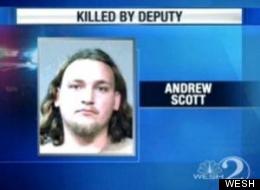
Police shot and killed Andrew Scott, but they really had the wrong man.
Police in Florida fatally shot an innocent man over the weekend after they mistook him for an attempted murder suspect.
Lake County sheriff's deputies were searching for a man named Jonathan Brown when they arrived at the Blueberry Hills Apartment complex in Leesburg early Sunday morning.
When the police banged on the wrong door, Andrew Lee Scott -- who did not expect visitors -- answered armed and ready, only to be fired at by the surprised officers.
"When we knocked on the door, the door opened and the occupant of that apartment was pointing a gun at deputies and that's when we opened fire and killed him," said Lt. John Herrell, according to WESH.
Officers admit they never identified themselves to Scott, a 26-year-old pizza deliveryman. Still, Herrell holds the victim at least partially responsible.
"It's just a bizarre set of circumstances," he said. "The bottom line is, you point a gun at a deputy sheriff or police office, you're going to get shot," Herrell said.
Jonathan Turley, a law professor at George Washington University, responded to the incident in his blog.
"This is technically not a 'no knock' search," Turley wrote. "In such searches, there is no knock but the officers are supposed to announce their identities in going into the property... Indeed, I have criticized the increasing use of 'no knock' warrants."
Police later arrested Brown and another suspect at a second apartment building. The two are currently at the Lake County Jail, the Orlando Sentinel reports.
The Florida Department of Law Enforcement is investigating the incident and police authorities placed the officer who shot Scott on administrative leave.
Lake County sheriff's deputies were searching for a man named Jonathan Brown when they arrived at the Blueberry Hills Apartment complex in Leesburg early Sunday morning.
When the police banged on the wrong door, Andrew Lee Scott -- who did not expect visitors -- answered armed and ready, only to be fired at by the surprised officers.
"When we knocked on the door, the door opened and the occupant of that apartment was pointing a gun at deputies and that's when we opened fire and killed him," said Lt. John Herrell, according to WESH.
Officers admit they never identified themselves to Scott, a 26-year-old pizza deliveryman. Still, Herrell holds the victim at least partially responsible.
"It's just a bizarre set of circumstances," he said. "The bottom line is, you point a gun at a deputy sheriff or police office, you're going to get shot," Herrell said.
Jonathan Turley, a law professor at George Washington University, responded to the incident in his blog.
Police later arrested Brown and another suspect at a second apartment building. The two are currently at the Lake County Jail, the Orlando Sentinel reports.
The Florida Department of Law Enforcement is investigating the incident and police authorities placed the officer who shot Scott on administrative leave.
Family hires attorney after deputies knock on wrong door, kill armed man
The family of an innocent Lake County man, who was shot and killed by deputies after they knocked on the wrong door, has hired an attorney. He talked exclusively to WFTV Thursday night.
Deputies killed Andrew Scott on Sunday when he answered the door with a gun in his hand, but deputies were at the wrong home.
"Someone knocked on the door, and an innocent man died in his house, so there are a lot of questions," said attorney Jason Recksiedler.
Recksiedler told WFTV he plans to launch his own investigation into what happened.
This news comes as Scott's friends protested in front of the Lake County Sheriff's Office demanding answers.
"I think he did what he thought he should do to protect his family. He was scared," said Scott's friend, Michelle Evey.
Recksiedler said the family is also puzzled by authorities' constantly changing story.
They first said deputies announced themselves at the door, and later said they didn't.
"That forces us to dig deeper to get the truth of what actually occurred," said Recksiedler.
He said it's too early to say whether the family will file a wrongful death lawsuit.
For the first time on Thursday, the sheriff defended the actions of the deputy and said he had no choice when Scott answered the door with a gun.
"At that point he defends himself and shoots. It's an unfortunate situation," said Sheriff Gary Borders.
The sheriff also said his heart goes out to Scott's family and he plans to reach out to them after some time has passed.

Saturday, June 30, 2012
Death Visits Culpepper County Virginia In The Guise Of Culpepper Police Officer Daniel Harmon-Wright
 |
| Daniel Harmon-Wright AKA Daniel Sullivan among other aliases being led out in handcuffs |
As of right now the murderous cop is being held on $100,000. bail, indicted on murder and three other felonies, and has been terminated. One witness before the Grand Jury testified that the murderer exceeded his autority by searching his home without a warrant and threatening them with a gun, and a woman 4 yrs before filed a complaint that the murderer pushed her so violently that she fell and needed medical treatment as a result. So excess of authority is not new to this murderer.
We all know that his "brother officers" will do everything they can to sweep this under the rug, call it a good shoot and well within policy. This time they may fail and he'll go to prison, where he belongs. In my opinion this should be a death penalty case, and he deserves the penalty of death.
Link to another case of police brutality by the murderer
Link to this case of muderby cop
Link to an early article
Link to article that talks about how Facebook helped
Husband files law suit
Saturday, December 17, 2011
Why Do the Police Have Tanks? The Strange and Dangerous Militarization of the US Police Force
I found this article on line at World Afternet and I'm passing it along as it is really scarey to those of us that are upset by the rapidly increasing police abuse in this country and in the rest of the world.
Link to Original Article
WORLD AlterNet / By Rania Khalek
Why Do the Police Have Tanks? The Strange and Dangerous Militarization of the US Police Force
The federal government has supplied local police departments with military uniforms, weaponry, vehicles, and training.
July 5, 2011
This article has been updated.
 Just after midnight on May 16, 2010, a SWAT team threw a flash-bang grenade through the window of a 25-year-old man while his 7-year-old daughter slept on the couch as her grandmother watched television. The grenade landed so close to the child that it burned her blanket. The SWAT team leader then burst into the house and fired a single shot which struck the child in the throat, killing her. The police were there to apprehend a man suspected of murdering a teenage boy days earlier. The man they were after lived in the unit above the girl's family.
The shooting death of Aiyana Mo'Nay Stanley-Jones sounds like it happened in a war zone. But the tragic SWAT team raid took place in Detroit.
Shockingly, paramilitary raids that mirror the tactics of US soldiers in combat are not uncommon in America. According to an investigation carried out by the Huffington Post's Radley Balko, "America has seen a disturbing militarization of its civilian law enforcement over the last 30 years, along with a dramatic and unsettling rise in the use of paramilitary police units for routine police work." In fact, Balko reports that "the most common use of SWAT teams today is to serve narcotics warrants, usually with forced, unannounced entry into the home."
Some 40,000 of these raids take place every year, and "are needlessly subjecting nonviolent drug offenders, bystanders and wrongly targeted civilians to the terror of having their homes invaded while they’re sleeping, usually by teams of heavily armed paramilitary units dressed not as police officers but as soldiers." And as demonstrated by the case of Aiyana Mo'nay Stanley-Jones, these raids have resulted in "dozens of needless deaths and injuries."
How did we allow our law enforcement apparatus to descend into militaristic chaos? Traditionally, the role of civilian police has been to maintain the peace and safety of the community while upholding the civil liberties of residents in their respective jurisdiction. In stark contrast, the military soldier is an agent of war, trained to kill the enemy.
Clearly, the mission of the police officer is incompatible with that of a soldier, so why is it that local police departments are looking more and more like paramilitary units in a combat zone? The line between military and civilian law enforcement has been drawn for good reason, but following the drug war and more recently, the war on terror, that line is inconspicuously eroding, a trend that appears to be worsening by the decade.
The Posse Comitatus Act of 1878 is a civil war-era law that prohibits the use of the military for domestic law enforcement. For a long time, Posse Comitatus was considered the law of the land, forcing militarization advocates to come up with creative ways to get around it. In addition to assigning various law enforcement duties to the military, such as immigration control, over the years Congress has instituted policies that encourage law enforcement to emulate combat soldiers. Hence, the establishment of the SWAT team in the 1960s.
Originally called the Special Weapons Attack Team, the Special Weapons and Tactics (SWAT) units were inspired by an incident in 1966, when an armed man climbed to the top of the 32-story clock tower at the University of Texas in Austin and fired randomly for 90 minutes, shooting 46 people and killing 15, until two police officers managed to kill him. This episode is said to have “shattered the last myth of safety Americans enjoyed [and] was the final impetus the chiefs of police needed” to form their own SWAT teams, according to an investigation by Diane Cecilia Weber. Soon after, the Los Angeles Police Department (LAPD) formed the country's first SWAT team, which “acquired national prestige when used against the Black Panthers in 1969.”
Use of these paramilitary units gradually increased throughout the 1970s, mostly in urban settings. The introduction of paramilitary units in America laid the foundation for the erosion of the barrier between police and military, a trend which accelerated in the 1980s under President Reagan, when the drug war was used as a pretext to make exceptions to the Posse Comitatus Act.
In 1981, Congress passed the Military Cooperation with Law Enforcement Act, which amended Posse Comitatus by directing the military to give local, state and federal law enforcement access to military equipment, research and training for use in the drug war. Following the authorization of domestic police and military cooperation, the 1980s saw a series of additional congressional and presidential maneuvers that blurred the line between soldier and police officer, ultimately culminating in a memorandum of understanding in 1994 between the US Department of Justice and Department of Defense. The agreement authorized the transfer of federal military technology to local police forces, essentially flooding civilian law enforcement with surplus military gear previously reserved for use during wartime.
Weber found that "Between 1995 and 1997 the Department of Defense gave 1.2 million pieces of military hardware, including 3,800 M-16s, 2,185 M-14s, 73 grenade launchers and 112 armored personnel carriers" to law enforcement around the country. But this was only the beginning.
In 1997, Congress, not yet satisfied with the flow of military hardware to local police, passed the National Defense Authorization Security Act which created the Law Enforcement Support Program, an agency tasked with accelerating the transfer of military equipment to civilian police departments. Between January 1997 and October 1999, the new agency facilitated the distribution of "3.4 million orders of Pentagon equipment to over 11,000 domestic police agencies in all 50 states. By December 2005, that number increased to 17,000, with a purchase value of more than $727 million of equipment," says Balko. Among the hand-me-downs, Balko counts: "253 aircraft (including six- and seven-passenger airplanes, and UH-60 Blackhawk and UH-1 Huey helicopters), 7,856 M-16 rifles, 181 grenade launchers, 8,131 bulletproof helmets, and 1,161 pairs of night-vision goggles."
The military surplus program and paramilitary units feed off one another in a cyclical loop that has caused an explosive growth in militarized crime control techniques. With all the new high-tech military toys the federal government has been funneling into local police departments, SWAT teams have inevitably multiplied and spread across American cities and towns in both volume and deployment frequency. Criminologist Peter Kraska found that the frequency of SWAT operations soared from just 3,000 annual deployments in the early 1980s to an astonishing 40,000 raids per year by 2001, 75-80 percent of which were used to deliver search warrants.
Balko cites Kraska's research from 1997, which observed that close to "90 percent of cities with populations exceeding 50,000 and at least 100 sworn officers had at least one paramilitary unit, twice as many as in the mid 1980s." He correctly points out that "the trends giving rise to SWAT proliferation in the 1990s have not disappeared, so it's safe to assume that these numbers have continued to rise and are significantly higher today."
Then there are the effects of the war on terror, which sparked the creation of the Department of Homeland Security (DHS) and the introduction of DHS grants to local police departments. These grants are used to purchase policing equipment, although law enforcement is investing in more than just bullet-proof vests and walkie talkies. DHS grants have led to a booming law enforcement industry that specifically markets military-style weaponry to local police departments. If this sounds familiar, that's because it is law enforcement's version of the military-industrial-complex.
By instituting public policies that encouraged the collaboration of military and domestic policing, the US government handed a massive and highly profitable clientele to private suppliers of paramilitary gear. Following the breakdown of Posse Comitatus in the 1980s and '90s, Peter Cassidy writes in Covert Action Quarterly that "gun companies, perceiving a profitable trend, began aggressively marketing automatic weapons to local police departments, holding seminars, and sending out color brochures redolent with ninja-style imagery."
Private suppliers of military equipment advertise a glorified version of military-style policing attire to local police departments and SWAT teams. One such defense manufacturing company, Heckler and Koch, epitomized this aggressive marketing tactic with its slogan for the MP5 submachine gun, “From the Gulf War to the Drug War—Battle Proven.”
Today's latest in paramilitary fashion sweeping through local police departments is the armored tank, which is making appearances all over the country at an increasingly alarming rate. The police department in Roanoke, Virginia paid Armet Armored Vehicles, a private company that specializes in military vehicles, $218,000 to assemble a 20,000-pound bulletproof tank with a $245,000 federal grant.
Not to feel left out, the Special Emergency Response Team (SERT) in Lancaster, PA, was recently seen sporting the Lenco BearCat, a camouflage colored Humvee-styled tank that can “knock down a wall, pull down a fence, withstand small-arms fire and deliver a dozen heavily armed police officers to a tense emergency scene,” according to a local news report. The BearCat was purchased a year and a half ago with a $226,224 grant from DHS, yet it has spent nearly two years sitting in a garage at the county's Public Safety Training Center.
The most widely used justification for the purchase of heavily armored war machines is that violence against police officers has increased exponentially, necessitating the tank for protection of the men and women who serve our communities. But examination of the FBI's annual Uniform Crime Report, a database that tracks the number of law enforcement officers killed and assaulted each year, reveals that this is simply not true. According to the UCR, since 2000 an average yearly toll of about 50 police officers have been feloniously killed, the highest reaching 70 in 2001. So the notion that militarization is a necessary reaction to a growth in violence against police officers is absurd, considering that violent crime is trending downward.
Others argue these tanks are needed in case of a terrorist attack or a natural disaster. But on September 11, 2001, I do not recall the NYPD complaining that a lack of armored tanks was impeding its policing efforts. And during the catastrophic tornado that tore through Joplin, Missouri earlier this year, heavily armored vehicles weren't present nor were they needed to assist in the aftermath.
The majority of paramilitary drug raid proponents maintain that military-style law enforcement is required to reduce the risk of potential violence, injury and death to both police officers and innocents. Based on Balko’s investigations, the reality is that SWAT team raids actually “escalate provocation, usually resulting in senseless violence in what would otherwise be a routine, nonviolent police procedure.”
Just consider your reaction in the event of a SWAT team breaking down your door in the middle of night, possibly even blowing off the hinges with explosives, while you and your family are asleep. Imagine the terror of waking up to find complete strangers forcing their way into your home and detonating a flash-bang grenade, meant to disorient you. Assuming nobody is hurt, what thoughts might be raging in your mind while the police forcefully incapacitate you and your loved ones, most likely at gunpoint, while carrying out a search warrant of your home. Assuming you were able to contain the mix of fear and rage going through your body, consider how helpless you would feel to know that any perceived noncompliance would most certainly be met with lethal force.
Training and technology-sharing between the defense and civilian law enforcement seems responsible for the pervasive culture of militarism plaguing domestic law enforcement. In fact, an estimated 46 percent of paramilitary units were trained by "active-duty military experts in special operations." Lawrence Korb, a former official in the Reagan administration, famously said that soldiers are “trained to vaporize, not Mirandize." As police officers continue to emulate soldiers in their weaponry, language, tactics, uniform, and mindset, it won't be long before they vaporize instead of Mirandize as well.
We have created circumstances under which the American people are no longer individuals protected by the Bill of Rights, but rather "enemy combatants." The consequences of such a mindset have proven time and again to be lethal, as we now rely on military ideology and practice to respond to crime and justice. For some insight into the implications, one needn't look any further than minority communities, which have long been the victims of paramilitary forces posing as police officers. Black and Latino communities in the inner-cities of Washington DC, Detroit and Chicago have witnessed first-hand the deadly consequences of militarization on American soil. Military culture now permeates all aspects of our society. Does anyone really believe that heavily armed soldiers trained to kill are capable of maintaining an atmosphere of nonviolence?
It's important to remember that police officers are not responsible for instituting these policies. Over the last three decades local police departments supplied with military uniforms, weaponry, vehicles, and training, were told they were fighting a war on drugs, crime and terror. The politicians who instituted these policies are responsible for the militarization creeping into civilian law enforcement. What might the end result be if the distinction between police and military ceases to exist? The answer is a police state -- and certain segments of our society are already living in one.
EDITOR'S NOTE: This article has been corrected since its original publication for more accurate attribution to original sources.
Rania Khalek is a progressive activist. Check out her blog Missing Pieces or follow her on Twitter @Rania_ak. You can contact her at raniakhalek@gmail.com.
Link to Original Article
WORLD AlterNet / By Rania Khalek
Why Do the Police Have Tanks? The Strange and Dangerous Militarization of the US Police Force
The federal government has supplied local police departments with military uniforms, weaponry, vehicles, and training.
July 5, 2011
This article has been updated.
The shooting death of Aiyana Mo'Nay Stanley-Jones sounds like it happened in a war zone. But the tragic SWAT team raid took place in Detroit.
Shockingly, paramilitary raids that mirror the tactics of US soldiers in combat are not uncommon in America. According to an investigation carried out by the Huffington Post's Radley Balko, "America has seen a disturbing militarization of its civilian law enforcement over the last 30 years, along with a dramatic and unsettling rise in the use of paramilitary police units for routine police work." In fact, Balko reports that "the most common use of SWAT teams today is to serve narcotics warrants, usually with forced, unannounced entry into the home."
Some 40,000 of these raids take place every year, and "are needlessly subjecting nonviolent drug offenders, bystanders and wrongly targeted civilians to the terror of having their homes invaded while they’re sleeping, usually by teams of heavily armed paramilitary units dressed not as police officers but as soldiers." And as demonstrated by the case of Aiyana Mo'nay Stanley-Jones, these raids have resulted in "dozens of needless deaths and injuries."
How did we allow our law enforcement apparatus to descend into militaristic chaos? Traditionally, the role of civilian police has been to maintain the peace and safety of the community while upholding the civil liberties of residents in their respective jurisdiction. In stark contrast, the military soldier is an agent of war, trained to kill the enemy.
Clearly, the mission of the police officer is incompatible with that of a soldier, so why is it that local police departments are looking more and more like paramilitary units in a combat zone? The line between military and civilian law enforcement has been drawn for good reason, but following the drug war and more recently, the war on terror, that line is inconspicuously eroding, a trend that appears to be worsening by the decade.
The Posse Comitatus Act of 1878 is a civil war-era law that prohibits the use of the military for domestic law enforcement. For a long time, Posse Comitatus was considered the law of the land, forcing militarization advocates to come up with creative ways to get around it. In addition to assigning various law enforcement duties to the military, such as immigration control, over the years Congress has instituted policies that encourage law enforcement to emulate combat soldiers. Hence, the establishment of the SWAT team in the 1960s.
Originally called the Special Weapons Attack Team, the Special Weapons and Tactics (SWAT) units were inspired by an incident in 1966, when an armed man climbed to the top of the 32-story clock tower at the University of Texas in Austin and fired randomly for 90 minutes, shooting 46 people and killing 15, until two police officers managed to kill him. This episode is said to have “shattered the last myth of safety Americans enjoyed [and] was the final impetus the chiefs of police needed” to form their own SWAT teams, according to an investigation by Diane Cecilia Weber. Soon after, the Los Angeles Police Department (LAPD) formed the country's first SWAT team, which “acquired national prestige when used against the Black Panthers in 1969.”
Use of these paramilitary units gradually increased throughout the 1970s, mostly in urban settings. The introduction of paramilitary units in America laid the foundation for the erosion of the barrier between police and military, a trend which accelerated in the 1980s under President Reagan, when the drug war was used as a pretext to make exceptions to the Posse Comitatus Act.
In 1981, Congress passed the Military Cooperation with Law Enforcement Act, which amended Posse Comitatus by directing the military to give local, state and federal law enforcement access to military equipment, research and training for use in the drug war. Following the authorization of domestic police and military cooperation, the 1980s saw a series of additional congressional and presidential maneuvers that blurred the line between soldier and police officer, ultimately culminating in a memorandum of understanding in 1994 between the US Department of Justice and Department of Defense. The agreement authorized the transfer of federal military technology to local police forces, essentially flooding civilian law enforcement with surplus military gear previously reserved for use during wartime.
Weber found that "Between 1995 and 1997 the Department of Defense gave 1.2 million pieces of military hardware, including 3,800 M-16s, 2,185 M-14s, 73 grenade launchers and 112 armored personnel carriers" to law enforcement around the country. But this was only the beginning.
In 1997, Congress, not yet satisfied with the flow of military hardware to local police, passed the National Defense Authorization Security Act which created the Law Enforcement Support Program, an agency tasked with accelerating the transfer of military equipment to civilian police departments. Between January 1997 and October 1999, the new agency facilitated the distribution of "3.4 million orders of Pentagon equipment to over 11,000 domestic police agencies in all 50 states. By December 2005, that number increased to 17,000, with a purchase value of more than $727 million of equipment," says Balko. Among the hand-me-downs, Balko counts: "253 aircraft (including six- and seven-passenger airplanes, and UH-60 Blackhawk and UH-1 Huey helicopters), 7,856 M-16 rifles, 181 grenade launchers, 8,131 bulletproof helmets, and 1,161 pairs of night-vision goggles."
The military surplus program and paramilitary units feed off one another in a cyclical loop that has caused an explosive growth in militarized crime control techniques. With all the new high-tech military toys the federal government has been funneling into local police departments, SWAT teams have inevitably multiplied and spread across American cities and towns in both volume and deployment frequency. Criminologist Peter Kraska found that the frequency of SWAT operations soared from just 3,000 annual deployments in the early 1980s to an astonishing 40,000 raids per year by 2001, 75-80 percent of which were used to deliver search warrants.
Balko cites Kraska's research from 1997, which observed that close to "90 percent of cities with populations exceeding 50,000 and at least 100 sworn officers had at least one paramilitary unit, twice as many as in the mid 1980s." He correctly points out that "the trends giving rise to SWAT proliferation in the 1990s have not disappeared, so it's safe to assume that these numbers have continued to rise and are significantly higher today."
Then there are the effects of the war on terror, which sparked the creation of the Department of Homeland Security (DHS) and the introduction of DHS grants to local police departments. These grants are used to purchase policing equipment, although law enforcement is investing in more than just bullet-proof vests and walkie talkies. DHS grants have led to a booming law enforcement industry that specifically markets military-style weaponry to local police departments. If this sounds familiar, that's because it is law enforcement's version of the military-industrial-complex.
By instituting public policies that encouraged the collaboration of military and domestic policing, the US government handed a massive and highly profitable clientele to private suppliers of paramilitary gear. Following the breakdown of Posse Comitatus in the 1980s and '90s, Peter Cassidy writes in Covert Action Quarterly that "gun companies, perceiving a profitable trend, began aggressively marketing automatic weapons to local police departments, holding seminars, and sending out color brochures redolent with ninja-style imagery."
Private suppliers of military equipment advertise a glorified version of military-style policing attire to local police departments and SWAT teams. One such defense manufacturing company, Heckler and Koch, epitomized this aggressive marketing tactic with its slogan for the MP5 submachine gun, “From the Gulf War to the Drug War—Battle Proven.”
Today's latest in paramilitary fashion sweeping through local police departments is the armored tank, which is making appearances all over the country at an increasingly alarming rate. The police department in Roanoke, Virginia paid Armet Armored Vehicles, a private company that specializes in military vehicles, $218,000 to assemble a 20,000-pound bulletproof tank with a $245,000 federal grant.
Not to feel left out, the Special Emergency Response Team (SERT) in Lancaster, PA, was recently seen sporting the Lenco BearCat, a camouflage colored Humvee-styled tank that can “knock down a wall, pull down a fence, withstand small-arms fire and deliver a dozen heavily armed police officers to a tense emergency scene,” according to a local news report. The BearCat was purchased a year and a half ago with a $226,224 grant from DHS, yet it has spent nearly two years sitting in a garage at the county's Public Safety Training Center.
The most widely used justification for the purchase of heavily armored war machines is that violence against police officers has increased exponentially, necessitating the tank for protection of the men and women who serve our communities. But examination of the FBI's annual Uniform Crime Report, a database that tracks the number of law enforcement officers killed and assaulted each year, reveals that this is simply not true. According to the UCR, since 2000 an average yearly toll of about 50 police officers have been feloniously killed, the highest reaching 70 in 2001. So the notion that militarization is a necessary reaction to a growth in violence against police officers is absurd, considering that violent crime is trending downward.
Others argue these tanks are needed in case of a terrorist attack or a natural disaster. But on September 11, 2001, I do not recall the NYPD complaining that a lack of armored tanks was impeding its policing efforts. And during the catastrophic tornado that tore through Joplin, Missouri earlier this year, heavily armored vehicles weren't present nor were they needed to assist in the aftermath.
The majority of paramilitary drug raid proponents maintain that military-style law enforcement is required to reduce the risk of potential violence, injury and death to both police officers and innocents. Based on Balko’s investigations, the reality is that SWAT team raids actually “escalate provocation, usually resulting in senseless violence in what would otherwise be a routine, nonviolent police procedure.”
Just consider your reaction in the event of a SWAT team breaking down your door in the middle of night, possibly even blowing off the hinges with explosives, while you and your family are asleep. Imagine the terror of waking up to find complete strangers forcing their way into your home and detonating a flash-bang grenade, meant to disorient you. Assuming nobody is hurt, what thoughts might be raging in your mind while the police forcefully incapacitate you and your loved ones, most likely at gunpoint, while carrying out a search warrant of your home. Assuming you were able to contain the mix of fear and rage going through your body, consider how helpless you would feel to know that any perceived noncompliance would most certainly be met with lethal force.
Training and technology-sharing between the defense and civilian law enforcement seems responsible for the pervasive culture of militarism plaguing domestic law enforcement. In fact, an estimated 46 percent of paramilitary units were trained by "active-duty military experts in special operations." Lawrence Korb, a former official in the Reagan administration, famously said that soldiers are “trained to vaporize, not Mirandize." As police officers continue to emulate soldiers in their weaponry, language, tactics, uniform, and mindset, it won't be long before they vaporize instead of Mirandize as well.
We have created circumstances under which the American people are no longer individuals protected by the Bill of Rights, but rather "enemy combatants." The consequences of such a mindset have proven time and again to be lethal, as we now rely on military ideology and practice to respond to crime and justice. For some insight into the implications, one needn't look any further than minority communities, which have long been the victims of paramilitary forces posing as police officers. Black and Latino communities in the inner-cities of Washington DC, Detroit and Chicago have witnessed first-hand the deadly consequences of militarization on American soil. Military culture now permeates all aspects of our society. Does anyone really believe that heavily armed soldiers trained to kill are capable of maintaining an atmosphere of nonviolence?
It's important to remember that police officers are not responsible for instituting these policies. Over the last three decades local police departments supplied with military uniforms, weaponry, vehicles, and training, were told they were fighting a war on drugs, crime and terror. The politicians who instituted these policies are responsible for the militarization creeping into civilian law enforcement. What might the end result be if the distinction between police and military ceases to exist? The answer is a police state -- and certain segments of our society are already living in one.
EDITOR'S NOTE: This article has been corrected since its original publication for more accurate attribution to original sources.
Rania Khalek is a progressive activist. Check out her blog Missing Pieces or follow her on Twitter @Rania_ak. You can contact her at raniakhalek@gmail.com.
Subscribe to:
Posts (Atom)


